Resources
Take advantage of these educational resources to share with your patients and staff.
Watch Dr. Albert's Talk About the Impact of Gout
Dr. Albert, a rheumatologist who specializes in gout, discusses gout misunderstandings, the drivers of this progressive, systemic disease, associated comorbidities, and the impact gout can have on the body—along with a patient’s perspective.
Chapters
Chapter 1
Dr. Albert
Gout is one of the oldest known diseases, yet it remains one of the most misunderstood.
Hi, my name is John Albert. I am a rheumatologist at the Rheumatic Disease Center in Milwaukee and Glendale, Wisconsin.
I've treated hundreds of patients with uncontrolled gout and have seen how deeply misunderstood this disease is.
Gout doesn't kill you, but it can make your life challenging. Like I always say, it's not your grandfather's gout.
Today, I'm joined by someone who knows the realities of uncontrolled gout all too well. Paul, thanks for being here today. Please tell us a little about your journey with gout.
Paul:
Hi, I'm Paul Czajka. I've lived with gout for over 25 years. This disease reshaped my life in ways I never saw coming.
Dr. Albert:
Too often, gout is dismissed as just flares in the toe. But what I see in practice, and what Paul has lived through, is something much more serious.
In reality, it is a progressive, systemic disease driven by persistently high serum uric acid levels and genetic factors.
Even with current therapies, many patients continue to experience elevated uric acid, which can silently damage organs and can increase the risk of serious comorbidities
Paul:
That was me. I didn't have flares in my toe, I had pain in my knees, hands, and ankles. For years, no one even looked for gout because my symptoms didn't match the textbook. Meanwhile, the disease was spreading.
I was in my 20s. Fit, active, running miles a week.
But the pain kept growing, until I couldn't walk upstairs, tie my shoes, or type with both hands.
Dr. Albert:
Here's what I always say, "Gout doesn't come looking for you. You have to go looking for it."
If we're only waiting for visible tophi or acute flares, we're missing a huge part of the disease.
Uric acid builds up silently; it doesn't just trigger flares. Uric acid can cause inflammation, joint erosion, kidney damage, and cardiovascular risk. And it doesn't stop building up when the flare ends.
Paul:
For a long time, I thought if I was not in pain, I was fine, but the disease was still active. By the time I understood uric acid buildup, I'd already had multiple surgeries for the removal of tophi and lost full motion in some fingers.
Dr. Albert:
I try to drive this home with my peers: "You're not just treating symptoms. You're managing a chronic, systemic, inflammatory process."
Absence of symptoms does not mean absence of disease activity.
Chapter 2:
Paul:
I got used to pain. I lived with it quietly. But it made me irritable and disconnected. I missed time with my kids. And worse, some people assumed it was my fault.
When I was blamed for something I couldn't control, it was isolating. I started hiding my hands, my pain, my emotions.
I stopped drinking. Changed my diet. Took medications prescribed by my physicians. But I was still flaring, still hurting. At one point, I was told, "There's nothing else we can do." That was crushing.
Dr. Albert:
As you know Paul, gout shaming is real. Patients are told it's a result of what they eat or how they live—but that's not always right.
We need to move beyond the flare. Beyond diet . Beyond wait and see.
Modifications to diet and lifestyle help but may not be enough. Especially in advanced disease, the body simply can't excrete enough uric acid. That is why sometimes, some patients, for example like Paul, may not benefit from these changes alone.
The real drivers are genetics, comorbidities, impaired uric acid excretion due to gut microbiome, and medications such as diuretics and low dose aspirin.
In my practice, I aim for a uric acid level of under 5 mg/dL, preferably closer to 2 or 3 mg/dL if we're trying to dissolve tophi. Lowering uric acid levels helps address an underlying cause, not just the symptoms.
Paul:
I didn't even know what my uric acid level meant. No one explained that to me until Dr. Albert did. If I had known what was really going on inside my body, I might have pushed for more, earlier.
Dr. Albert
And here's the irony: we check cholesterol and A1c, but we often skip uric acid. Why?
Paul:
If you're living with gout that isn't getting better, speak up and push for answers. You deserve to be listened to and to feel better.
Like you did for me.
Dr. Albert:
There are many different faces of gout; don't stop at symptom relief. This may be why a number of patients remain uncontrolled and undertreated.
As healthcare professionals, we must listen, challenge our assumptions, and do better for patients with uncontrolled gout.
Look at the full picture. Listen to your patients. And remember: the flare isn't the problem—it's the warning sign.
Paul, thank you for sharing your story. And thank you to everyone watching and for being part of this important conversation.
The more we listen, the more we know, the better we treat.
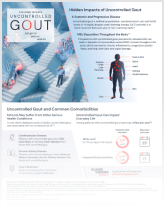
Uncontrolled Gout Flashcard
Use this flashcard for a brief overview of the negative impacts persistently high serum uric acid (sUA) levels and monosodium urate (MSU) crystal buildup can have on the body.1

InsideGout.com
Share this website with your patients to show the broader picture of gout. They can also sign up for email communications to keep them up to date on any new information available on the site.

The Goutspoken Patient Ambassador Program
Do you have a patient who would like to share their gout story with others in the community? Share InsideGout.com with them to sign up to learn more.
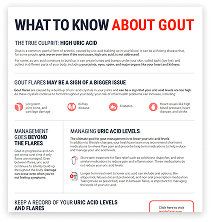
Patient Education Flashcard
Share this flashcard with your patients to help them understand the impact of high uric acid, what flares may signal, and gout management.1,2

Sign Up for Updates
Be the first to know about our updates in uncontrolled gout.
The information provided on this website is intended for healthcare professionals (HCPs) for informational and educational purposes only. It is not intended to replace the independent clinical judgment of HCPs in diagnosing or treating individual patients.
References
1. Morlock RJ, et al. Rheumatol Ther. 2025;12(1):37-51. 2. Francis-Sedlak M, et al. Rheumatol Ther. 2021;8(1):183-197.